

Home Homelessness Page 3
Homelessness
- Research
In a study on mothers’ experiences of a residential parenting and drug rehabilitation programme, housing was consistently discussed as crucial to recovery in terms of the ability of wāhine (women) to envision a secure future.
- Research
In State of the Housing System 2025, the National Housing Supply and Affordability Council (NHSAC or ‘the Council’) presents a sobering view of Australia’s housing system. The deterioration of housing affordability and low levels of new housing supply in 2024 are particularly stark reminders that Australia is still very much in a housing crisis that has been decades in the making.
- Research
In 2016, the Ministry of Social Development (MSD) of New Zealand introduced the Emergency Housing Special Needs Grant (EHSNG) to address urgent accommodation needs. This study utilised the Integrated Data Infrastructure (IDI) to analyse the demographics and government service utilisation of EHSNG recipients, including all household members, unlike previous reports that focused only on the main applicant.
- Research
Using baseline data from a study with suicidal youth experiencing homelessness, correlation and mediation analyses were completed to determine the associations between cognitive distortions, problem-solving, depressive symptoms, and suicidal ideation.
- Research
This qualitative study explores the perceptions of people experiencing chronic homelessness of mental health, mental health services, and any perceived barriers or facilitators to access.
- Research
Little research compares the financial costs of alternative and traditional shelter models. The research team analyzed cost data for 13 alternative shelters and nine traditional congregate shelters in Portland, Oregon.
- Research
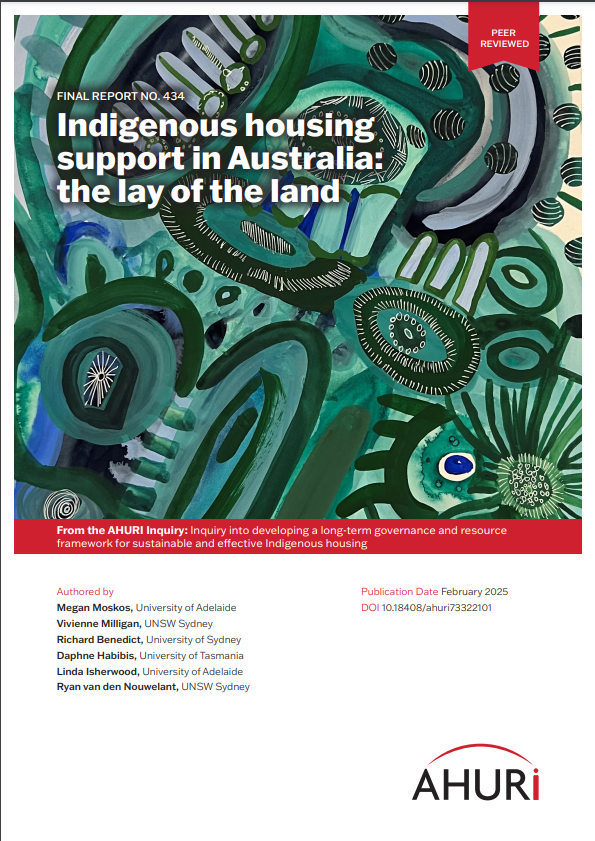
From the AHURI Inquiry: Inquiry into developing a long-term governance and resource framework for sustainable and effective Indigenous housing What this…
- Research
Persons with lived experience (LE) are increasingly recognized by researchers and funding agencies (e.g., the Patient-Centered Outcomes Research Institute) as valued…