

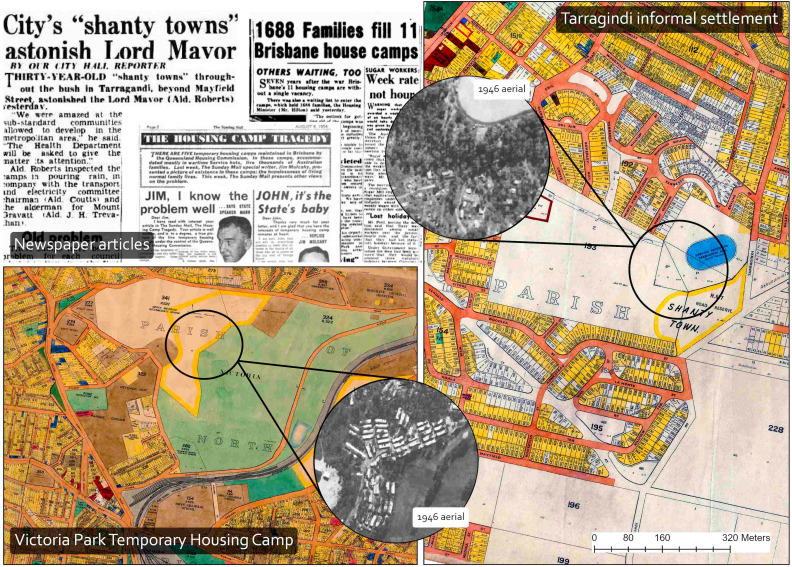
Informal settlements are often associated with cities in the global South, yet they also emerge in high-income countries during periods of acute housing shortage.
This study examines the spatial evolution of informal settlements, including temporary housing camps, in Brisbane (Australia). Through a mixed-methods approach, integrating urban morphology, spatial analysis, and archival research, findings reveal how these settlements were gradually absorbed into or reshaped by the surrounding urban fabric. By digitising historical land use maps and aerial imagery, this paper traces changes in pathways, building forms and property boundaries from 1951 to 2024. Archival materials, such as newspaper reports, add social and political context.
Findings show that these settlements, while often dismissed as temporary, persisted for decades until alleviated by substantial government investment in housing. While largely forgotten from historical narratives, informal settlements left lasting spatial and social imprints by shaping subsequent development on these sites. The legacy of informal settlements serves as powerful reminders of the consequences of housing scarcity, including in high income countries, and offer valuable lessons for contemporary urban policy, particularly the importance of recognising and planning for informal responses to housing crises.