

Home Affordable Housing Page 2
Affordable Housing
- Research
This paper investigates the application, design, and economic feasibility of prefabricated construction in Australian low-rise housing, with a focus on affordability and labour shortages.

- Research
This study’s findings suggest that provincial governments may have adopted foreign buyer taxes as a political expediency to signal government action on the housing crisis while sidestepping structural drivers of unaffordability in their housing markets.
- Research
This study reveals a “vulnerability trap” for low-income households and a “resilience divide” favoring affluent buyers, underscoring the need for distribution-sensitive climate adaptation housing policies.

- Research
The study aims to identify the best practices, challenges and opportunities for integrating sustainability and affordability in housing developments.
- Research
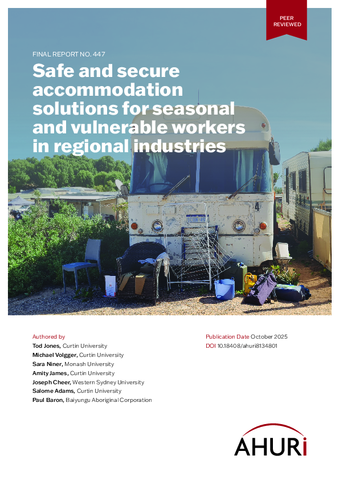
This research looked at ways seasonal and vulnerable workers in regional Australia can be better housed.
- Research
Regional Australia relies on a skilled and unskilled labour force, in part through migration schemes, to remain economically competitive. Regional workers are diverse and have diverse housing needs. This report develops an evidence-based policy framework for accommodating seasonal and vulnerable workers in regional areas to ensure a healthy, safe and productive workforce.
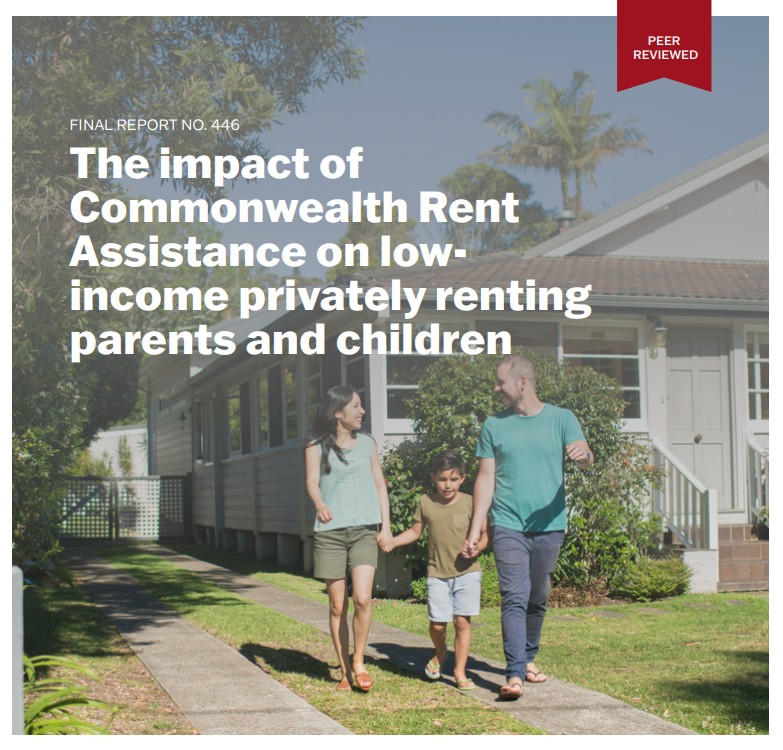
- Research
This research helps to understand how effective CRA is at reducing disadvantage and improving wellbeing, and also shows how these effects pass to children of households that receive CRA.

- Research
This paper presents a bibliometric analysis focusing on financing options for advancing sustainable 3D-printed concrete housing, particularly emphasising options accessible to end-users.