

Home Homelessness Page 20
Homelessness

- Research
[US government] grants were intended to enhance MAT access in the communities. However, it is unknown whether MAT-PDOA decreases an important consequence of the epidemic in communities: homelessness.
- Research
Based on qualitative fieldwork in Rotterdam, and using Van Dijk and Steinmetz’s risk model as a theoretical lens, we argue that irregular status, interacting with other relevant factors such as social capital, co-determines the men’s criminal victimization risks, and fear of crime.

- Research
Support services for individuals experiencing homelessness are encouraged to use trauma-informed models of care. This paper outlines a trauma-aware framework used for nearly a decade within a youth refuge located in Melbourne, Australia.
- Research
In this article, we probe the ethical, empirical, and political dimensions of state-driven responses to the COVID-19 public health crisis, surfacing some of the ways these interventions posed problems for people who are homeless and experience intersecting health and socio-political disparities.
- Research
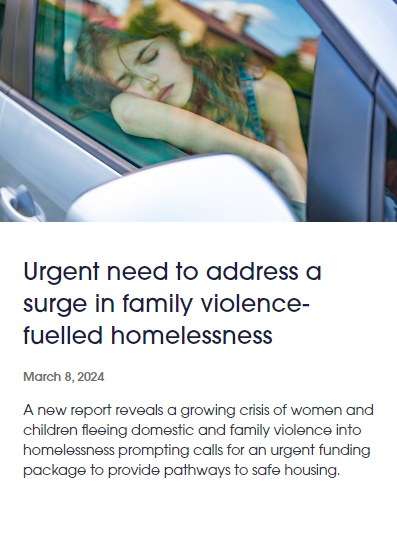
Homelessness Australia’s Homelessness and domestic and family violence: State of Response Report analyses Australian Institute of Health and Welfare data to find 45 per cent of women and girls seeking homelessness assistance do so due to family and domestic violence.
- Research
In this commentary, the authors examine a recent application of wastewater surveillance of COVID-19 in a men’s shelter in Toronto.
- Research
I suggest that researchers may better understand the ways in which homeless communities structure themselves, not only in relation to one another, but also in relation to the broader social world around them.
- Research
The US media is saturated with coverage of perceived threats to public safety by people experiencing homelessness with purported “mental illness.” This review seeks to harness our expertise in forensic psychiatry, addiction science, health policy research, social work, and adult psychiatry to highlight potential misinformation and provide an evidence-based update for clinical generalists.