

Home Research / Reports
Research / Reports

- Research
Homelessness among people with severe and persistent mental illness is a complex public health challenge, with homelessness and mental illness linked in a bi-directional relationship that worsens health outcomes and complicates effective care.
- Research
In 2024, the Organisation for Economic Co-operation and Development (OECD) and the EU estimated that more than two million people were experiencing homelessness across the 38 member countries.

- Research
Often, young people leaving out-of-home care and homelessness services receive minimal ongoing support, complicating their transition to independent living.

- Research
Aboriginal and Torres Strait Islander peoples are deeply connected to the lands, seas and skies across the settler-colonial state of Australia. They take strength from ongoing connection to culture, spirituality and community.
- Research
Mental Health Treatment Courts and Assertive Community Treatment offer complimentary solutions for addressing needs of justice-involved individuals with serious mental illness (SMI) and co-occurring disorders (COD).

- Research
People living with a severe mental illness are more likely to experience food insecurity than people without mental illness. Food insecurity is linked to a range of negative socioeconomic and health outcomes. This study qualitatively explored causes and experiences of food insecurity for people living with a severe mental illness and used these findings to co-design a pilot intervention.
- Research
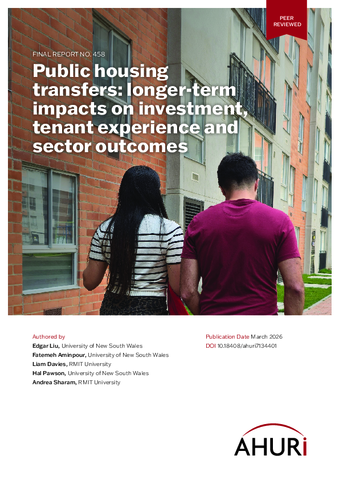
This project examines the long-term impacts of transferring public housing to community housing providers (CHPs) in Australia.
- Research
Do projects learn across space and time? This study looks at the cost overruns of hosting the Olympic Games between 1960 to 2024 to find out why what should be a ‘positive learning curve’ driving down costs from one iteration to the next, in fact produces no sustained improvement over 64 years.